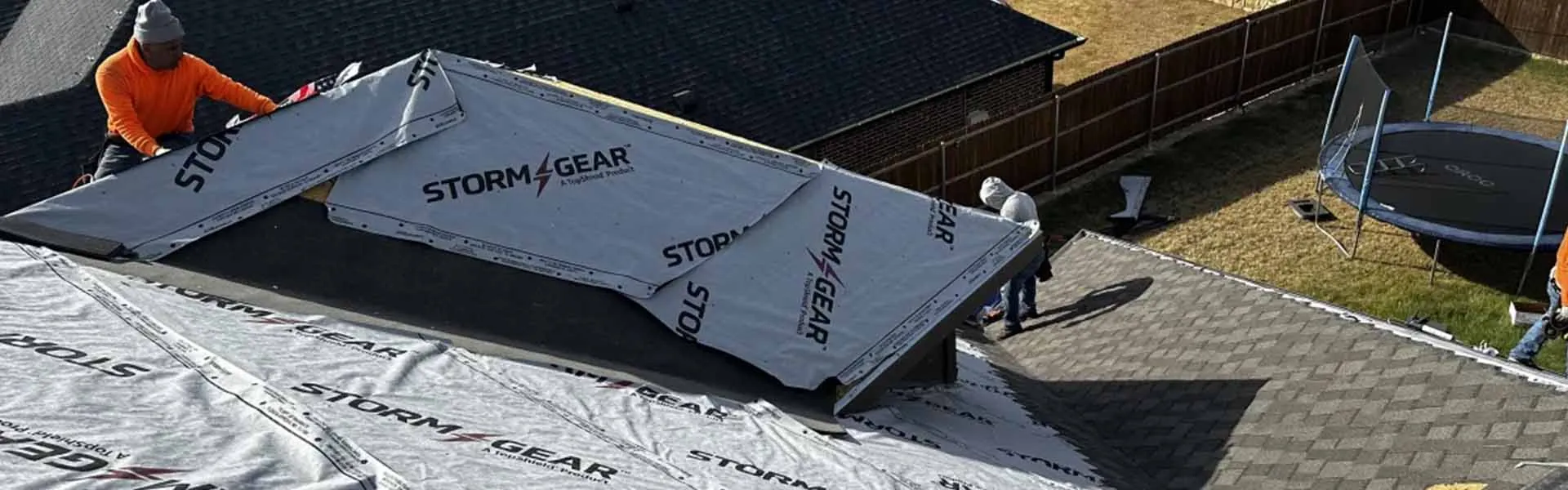
Roof underlayment is the sheet that goes on the bare wood of your roof before the shingles. Think of it as a raincoat under a jacket. The shingles shed most of the water. The underlayment catches what gets past them, like rain blown sideways in a storm or water that sneaks under a shingle that hail or wind has broken. When you get a new roof, the old underlayment comes off with the old shingles, and a new layer goes down. Asking what kind is a good way to tell a careful roofer from a rushed one.
Where it sits on your roof
From the outside in, a shingle roof has these layers:
- Shingles. The part you see from the street.
- Underlayment. The sheet under the shingles.
- Roof deck. The flat wood boards nailed to the frame. Everything else is fastened to it.
- Attic. The space under the deck.
The underlayment covers the whole deck, from the edges up to the peak. It is rolled out in long strips, from the bottom of the roof up. Each strip lays over the one below it, the way shingles do, so water runs down and off and not under.
What it does
- It is the backup. If a shingle cracks, blows off or gets hit by hail, the underlayment is what keeps the water out of the wood for a while.
- It keeps the wood dry during the job. When the old roof comes off, the crew puts underlayment down the same day. Roofers call this "drying in." Once the deck is dried in, a pop-up rain will not soak the house.
Underlayment is a backup, not a roof. It is made to sit under shingles, out of the sun. Left bare for weeks, the sun and heat wear it down. If a crew leaves your roof in underlayment for a long time, ask why.
The three main kinds
Felt. This is the old kind. It is paper or mat soaked in asphalt, the same black, tar-like stuff that is in shingles. It comes in a thinner and a thicker weight. It works. But it can tear when crews walk on it, it can wrinkle when it gets wet, and it can dry out and get brittle under a hot Texas roof over the years.
Synthetic. This is a woven plastic sheet. It is what most roofers use on homes now. It is harder to tear, it does not wrinkle in the rain, and it holds up better if a storm stalls the job for a day. The trade-off is that it costs more than felt. It can also be slick to walk on, so good crews take care with it.
Self-stick membrane. This is a thick, rubbery sheet with glue on the back. Some roofers call it "ice and water shield." It sticks right to the wood and seals around each nail that goes through it. It costs the most, so it is not usually put on the whole roof. It goes in the places where water is most likely to get in:
- Valleys. A valley is the low line where two slopes of the roof meet. Water from both sides runs down it, so it carries a lot of water in a hard rain.
- Around chimneys, skylights and walls. These spots have flashing (the metal where the roof meets a wall or chimney). The membrane goes under it as a second seal.
- Around pipes and vents. Every hole cut in the roof is a place water can find. Our post on pipe boot leaks covers one of the most common ones.
- Low-slope parts of the roof. Water moves slowly on a flat-ish porch or patio roof, so it has more time to sneak in.
Why it matters more in North Texas
Our weather is hard on roofs in a few ways that make the layer under the shingles count:
- Hail. In Crowley, Burleson, Mansfield and nearby towns, hail can crack shingles or knock off their grit. Until the roof is fixed, the underlayment is what stands between that damage and your ceiling.
- Wind. Strong storm winds can lift or tear off shingles. A good underlayment keeps the deck covered while you wait for a repair.
- Sideways rain. Spring storms push rain under the edges of shingles. The underlayment sends it back down and off the roof.
Signs the underlayment may be failing
You can not see underlayment on a finished roof, but you can see the signs when it stops working:
- Stains on the roof deck. In the attic, look up at the wood with a flashlight. Dark spots or streaks mean water has been getting through.
- A leak after a storm with no missing shingles. Water may be getting under the shingles and finding a weak spot below. Our post on ceiling water stains helps you track it down.
- An old roof. On a roof near the end of its life, the felt under it is often dry and brittle too.
Underlayment can not be swapped out on its own. To reach it, the shingles above it have to come off. So a small spot can be fixed during a repair, but new underlayment for the whole roof means a new roof.
Questions to ask your roofer
- What underlayment will you use? Get the kind, felt or synthetic, written in the estimate.
- Where will the self-stick membrane go? Valleys, walls, chimneys and pipes are the usual spots. Ask which ones your roof gets.
- Will you dry in each day? The crew should only tear off what it can cover the same day.
- What if you find bad wood? Soft or rotted boards should be replaced before the underlayment goes down. Ask how that is handled and how you will be told.
- Will you replace the drip edge and flashing too? These metal pieces work with the underlayment. New ones are better than reusing the old.
What to do next
If your roof is getting older or a storm has been through, start with our roof replacement page to see each layer we put on a new roof. Or set up a free drone roof survey. Someone needs to be home for the flight, and you see the pictures before we leave. You get a written photo report, and if something needs a closer look, it is checked by hand. Call Legacy Roofing at (817) 602-2057. We work in Crowley, Fort Worth, Burleson, Mansfield, Joshua and nearby towns.