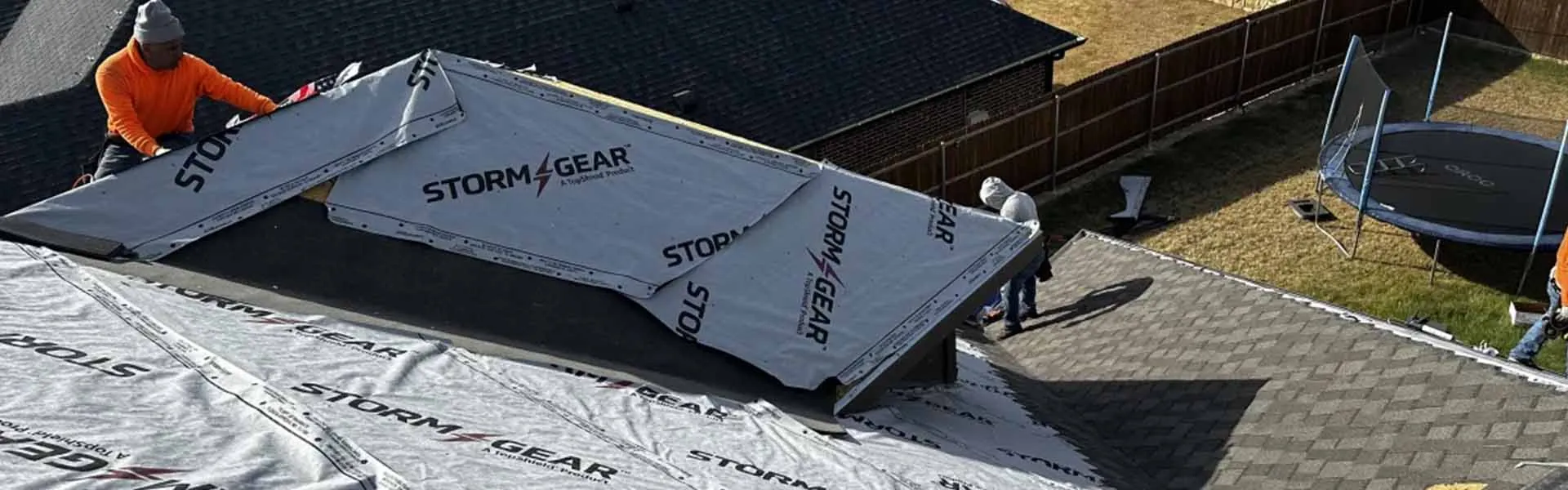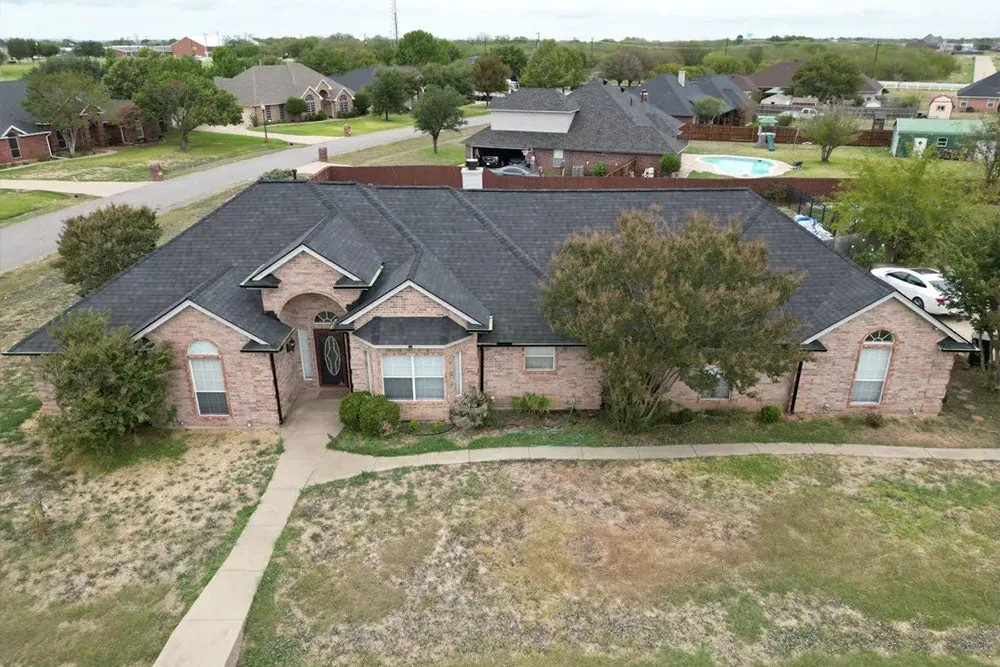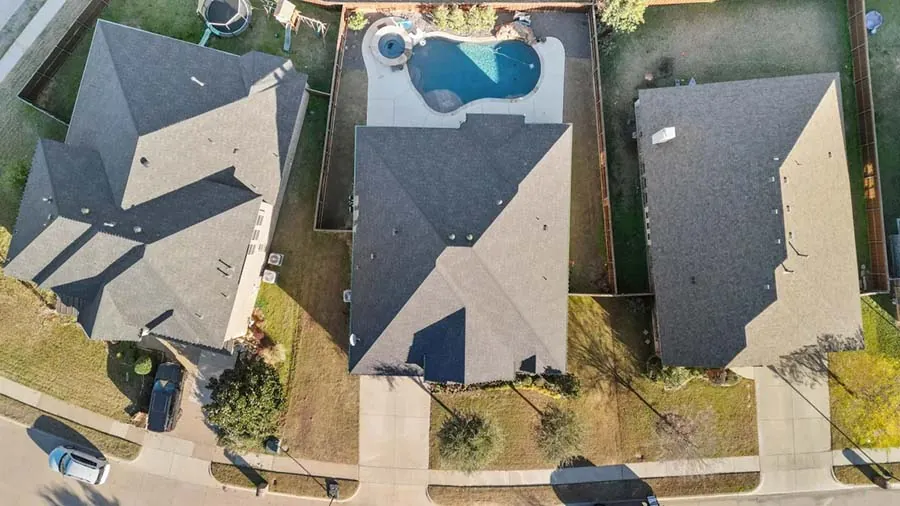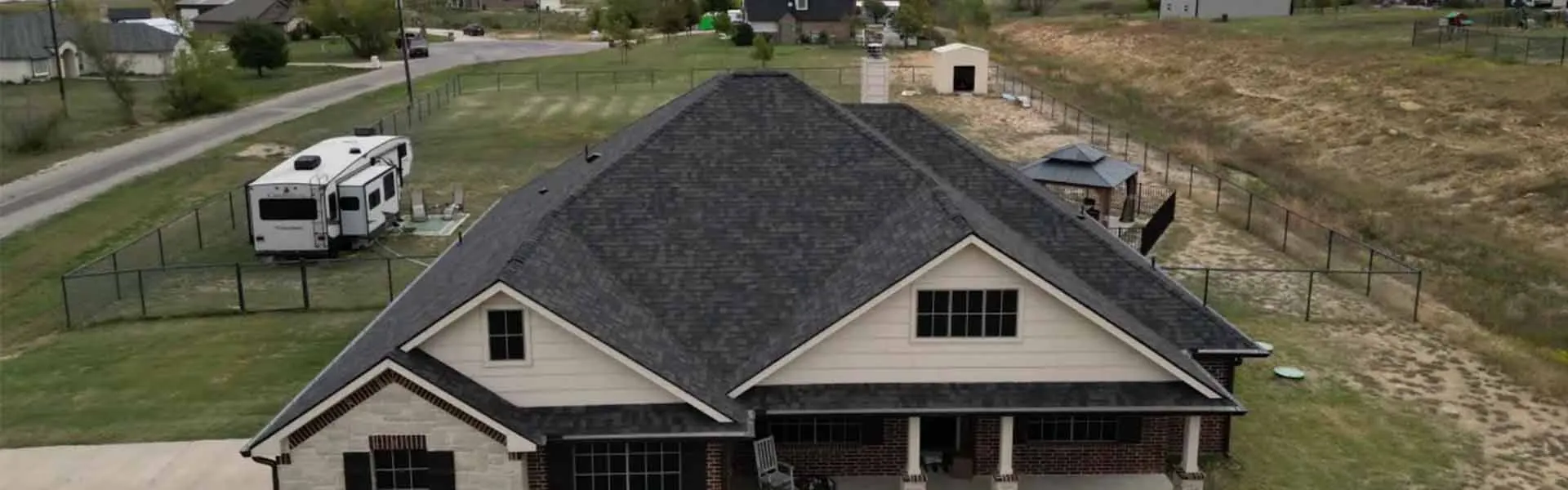
Flashing is the thin metal where your roof meets something else, like a wall, a chimney or a skylight. Drip edge is the metal strip along the edges of the roof. Both do one job: they send water down and away from the spots where it is most likely to get in. Shingles cover the flat parts of a roof well. The trouble starts at the joints and edges, and that is where most roof leaks begin. If you have a leak in Crowley, Fort Worth or Burleson and the shingles look fine, the flashing is one of the first places to look.
Why the joints are the weak spots
A roof is not one smooth sheet. It meets walls, wraps around chimneys, dips into valleys and stops at the edges. Each of those spots is a seam, and water is good at finding seams. Flashing covers those seams so the water has a path off the roof that does not go through it.
The main kinds of flashing
- Step flashing. Small bent pieces of metal set where a roof slope runs up beside a wall, like the side of a second story or a dormer (a small part of the roof that sticks out with its own window). One piece goes with each row of shingles, like steps. Each piece laps over the one below it, so water runs down and out.
- Counter flashing. A second piece that covers the top of the step flashing. On brick, it is set into the mortar lines (the cement between the bricks). On siding, the siding laps over the flashing.
- Chimney flashing. A set of pieces that wraps all four sides of a chimney. On the high side, many chimneys need a small peaked piece called a cricket that splits the water so it does not pile up behind the chimney.
- Valley flashing. A valley is the low line where two slopes meet. Some roofs have a metal strip down the valley. Others lay shingles across it over a self-stick sheet. Either can work if it is done with care.
- Pipe and vent flashing. The collars around pipes and vents that come through the roof. Our post on pipe boot leaks covers these.
What drip edge does
Drip edge is a long, bent strip of metal along the bottom edges and the sloped sides of the roof. It does two things:
- It moves water out. Rain runs off the shingles, over the drip edge, and drops into the gutter or away from the house. Without it, water can curl back under the shingles and soak the edge of the roof deck (the wood boards under the roof).
- It guards the wood. It covers the edge of the deck and the top of the fascia (the board along the roof edge that the gutter hangs on), so they stay dry and do not rot.
Some older homes in Arlington and Fort Worth were built with no drip edge at all. On those houses you often see dark, soft wood along the roof edge or stains behind the gutters.
Why flashing fails
- Old sealant. Many joints are finished with a bead of caulk or roof cement. The Texas sun dries it out and it cracks. Sealant should be the backup, not the only thing keeping water out.
- Rust and wear. Thin metal can rust through over many years, most of all where water sits.
- Hail and wind. Hail can dent or crack flashing. Strong wind can lift a loose piece at the edge.
- Reused metal. On a new roof, some crews leave the old flashing in place and shingle up to it. Old metal on a new roof can fail long before the shingles do.
- Missing pieces. Step flashing left out, no cricket behind a wide chimney, or a "fix" that is just a smear of tar. These are signs of a rushed job.
Signs your flashing may be the problem
You can check a lot from the ground and from inside:
- A stain on a ceiling or wall near a chimney, skylight or a spot where the roof meets a wall. Our post on ceiling water stains helps you trace it.
- A leak only in hard, windy rain. Water blown sideways gets into gaps that a soft rain misses.
- Metal you can see that is bent, lifted, rusty or loose, or thick globs of tar or caulk around the chimney.
- Dark or soft wood at the roof edge, or paint peeling on the fascia boards behind the gutters.
- Water marks in the attic on the wood around a chimney or along a wall.
Look from the ground or through a window. Please do not climb on the roof to check.
Repair or replace?
Flashing can often be fixed on its own. A loose piece can be fastened and sealed. A bad section along a wall or around a chimney can be redone. That means lifting the shingles near it, setting new metal and laying the shingles back. Done well, that is a common, lasting repair.
The trade-off is that new metal next to old, worn shingles does not fix the rest of the roof. If the shingles are near the end of their life, it often makes more sense to redo the flashing with a new roof, so it all starts fresh at the same time. Our post on roof repair or replacement walks through that choice.
What to ask on a new roof
- Will you put on new drip edge on all the edges? It should be in the written estimate.
- Will you replace the step and chimney flashing, or reuse the old? New is better in most cases. If a piece is set into brick and in good shape, ask how it will be checked.
- Does my chimney need a cricket? A wide chimney often does.
- What goes under the valleys and walls? A self-stick sheet under the metal adds a second seal.
- Is the fix metal, or just sealant? Sealant alone should be a short-term patch, not the plan.
What to do next
If you have a leak near a chimney, a wall or the roof edge, see our roof repair page, or call Legacy Roofing at (817) 602-2057. We work in Crowley, Fort Worth, Burleson, Mansfield, Joshua and nearby towns. We will look at the flashing, the drip edge and the shingles around them and tell you plainly what we see and what it needs.